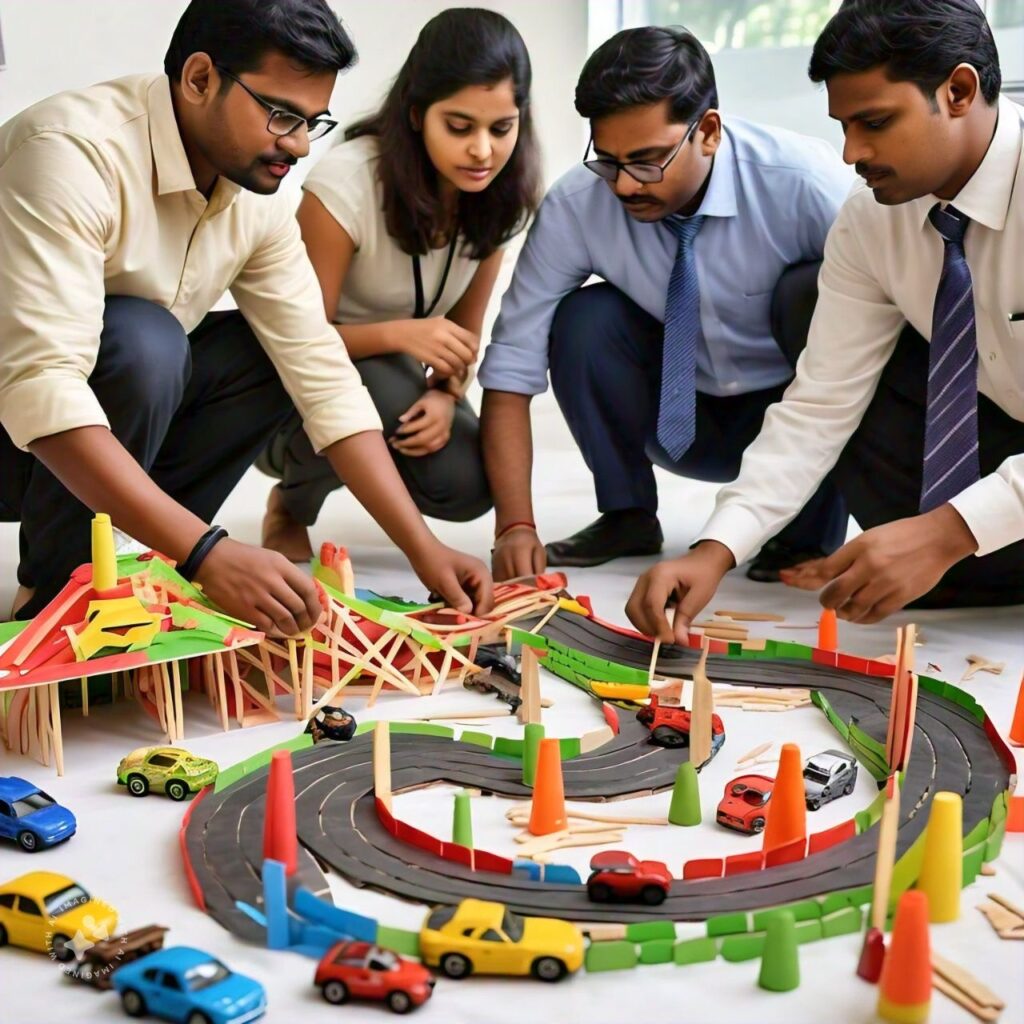
Give a team a fixed set of round tables and almost nothing else, and tell them their only job is to finish a track before anyone else does. What you’re actually watching isn’t a race. It’s what a team does when the fastest route runs directly through someone else’s territory.
Round tables become the raw terrain. Teams use them as the foundation to build out their own F1-inspired track – laps, flyovers, the works — racing to be the first to complete a functioning circuit. The layout isn’t neutral: track placement is deliberately complex, forcing routes to cross, merge, and bottleneck at a small number of shared intersection points.
Materials are intentionally minimal. There’s no kit built for one obvious solution – teams have to decide what’s structural, what’s a workaround, and what gets sacrificed to move faster.
Every team is racing to finish their own track first. But the shared intersections mean that somewhere in the middle of a highly competitive build, a team runs into a moment where the fastest move requires briefly coordinating with the people they’re racing against – a shared flyover, a blocked crossing, a resource someone else needs at the same time they do.
Most competitive formats remove collaboration by design – that’s what makes them feel competitive. Building Bridges does the opposite: it engineers a small number of moments where competition and collaboration are forced to happen in the same five minutes, on the same physical structure.
That’s a closer model of how real teams actually operate than either a pure race or a pure trust exercise. Nobody in a real organization gets to choose between competing for resources and collaborating with the people they’re competing against – they do both, often in the same conversation. Building Bridges puts that exact tension in front of a team physically, with a table and a track instead of a quarterly budget.
The minimal materials aren’t a limitation — they’re the point.
Scarcity is what turns the intersections from “nice to negotiate” into “impossible to avoid.”
Teams leave having practiced something harder to name in a debrief than to live through in the room: how to protect their own momentum without treating every shared point as a zero-sum conflict. What surfaces – who defaults to blocking, who instinctively negotiates, who slows their own build rather than risk a conflict at the intersection – becomes the actual material for the conversation afterward.
It’s not a lesson about collaboration. It’s ninety minutes of evidence about how this specific team already handles the moment when winning and working together stop being separate choices.