Ask ten L&D leaders what a team building day is supposed to achieve, and most will give you some version of the same answer: better collaboration, stronger morale, a team that “gels.”
Ask them six weeks later whether the day actually changed anything, and the answer gets quieter.
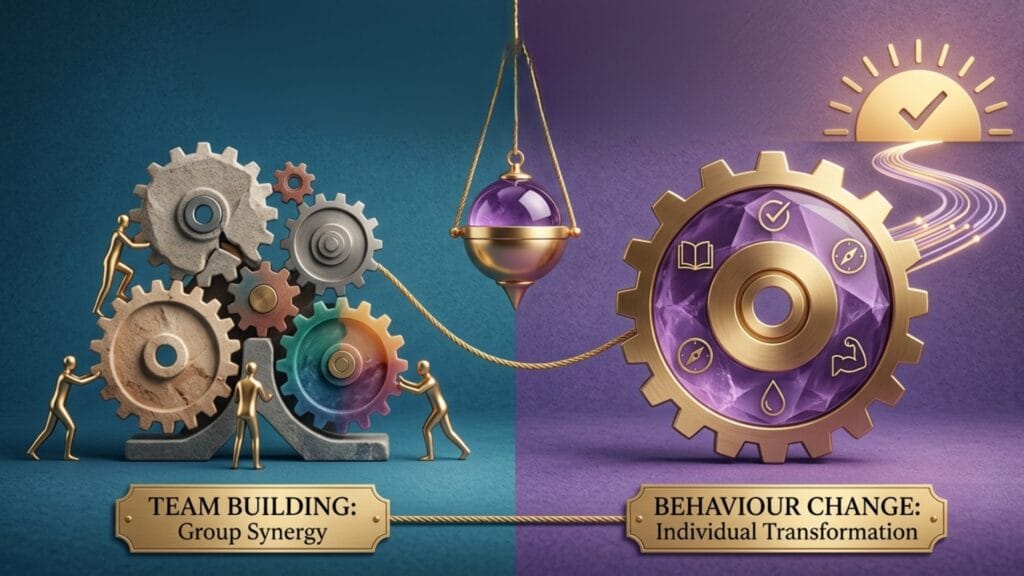
This isn’t a failure of effort. Most team building programs deliver exactly what they’re designed to deliver – a good day, a few laughs, a temporary lift in mood. The problem is that a good day and a changed behaviour are not the same outcome, and most programs were never built to produce the second one.
For L&D leaders under pressure to justify the budget with more than a satisfaction score, this distinction is worth getting precise about.
The Entertainment Trap
A large share of what gets sold as “team building” is, structurally, entertainment with a debrief attached. A physical challenge, a game, a shared experience – followed by a facilitator asking the group what they learned.
The activity produces genuine positive feelings. People do bond over shared discomfort or shared fun. But feeling closer to your colleagues for an afternoon is not the same as your team having internalised a new way of communicating under pressure, delegating trust, or handling disagreement.
The tell is simple: if the debrief is doing all the work of connecting the activity to a workplace behaviour, the activity itself wasn’t designed to teach that behaviour. It was designed to be enjoyable, and the lesson was bolted on afterward.
What Behaviour Change Actually Requires
Behavioural science has been fairly consistent on this point for decades: people don’t change how they act because they were told a good story about how they should act. They change because they rehearsed the new behaviour under conditions that resembled the real one, enough times that it became the default response rather than a conscious effort.
This is true of leadership behaviour, of team communication, of how people respond to ambiguity or conflict. Telling someone to “communicate more openly” changes almost nothing. Putting them inside a structured scenario where open communication is the only path to succeeding – and where the cost of not communicating is felt immediately, inside the activity itself – changes quite a lot.
The distinction that matters for L&D buyers evaluating a program isn’t “is this fun” or even “is this well-facilitated.” \
It’s: does the mechanic of the activity itself require the behaviour you’re trying to build, or does the activity just create an opportunity to talk about that behaviour afterward?
Behaviour Rehearsal vs. Behaviour Description
This is the design principle underneath STEMulus’s approach, formalised as See-Think-Experience-Manifest — a sequence, not a slogan.
- See: Participants are shown a real pattern (in leadership, in team dynamics, in decision-making) that they recognise from their own working lives.
- Think: They’re asked to reason about why that pattern exists and what it costs.
- Experience: They’re placed inside a structured activity where the mechanic of the activity forces them to either replicate the old pattern or practice the new one, with immediate, felt consequences either way.
- Manifest: The behaviour practiced inside the activity gets explicitly named and connected back to a specific workplace situation, so the transfer isn’t left to chance.
The critical step most team building programs skip is ‘Experience’ – not as “an activity happens,” but as a designed mechanic where the desired behaviour is the only route to a good outcome. Without that step, See and Think produce insight. They don’t produce a rehearsed instinct.
This is also why “debrief quality” is the wrong metric to evaluate a program on.
A brilliant facilitator can extract insight from almost any activity, including ones that taught nothing structurally. The activity’s design should be doing more of the work than the facilitator’s ability to talk about it afterward.
Engagement Is Not a Perk. It’s Structural Reinforcement.
There’s a related confusion worth naming: engagement gets treated as morale — a nice-to-have that makes people feel good about coming to work.
Engagement, properly understood, is the mechanism that keeps a practiced behaviour from decaying. A single day of behaviour rehearsal, however well designed, fades without reinforcement. Ongoing engagement – recurring touchpoints, repeated smaller experiences, structural cues built into how a team actually works, is what keeps a new behaviour from reverting to the old default once the offsite ends and the deadline pressure returns.
Programs that treat engagement as a one-time event and behaviour change as a byproduct of that event are optimising for the wrong sequence. Sustainable change looks less like a single peak experience and more like a series of smaller, structurally reinforced ones.
What This Means for L&D Leaders Evaluating a Vendor
A few questions worth asking any team building or experiential learning vendor, before signing off on a program:
- What specific behaviour is this activity mechanically designed to require
– and not describe, require – and how does the activity fail if that behaviour doesn’t show up?
- What happens after the debrief?
Is there a reinforcement structure, or does the learning live only on the day it happened?
- Would this activity work as well with a group that skipped the debrief entirely?
If yes, the insight was baked into the mechanic. If not, the insight was only ever in the facilitator’s script.
None of this is an argument against enjoyment -in fact, a well-designed experiential program should be genuinely engaging, not a disguised classroom. But enjoyment is the byproduct of good design, not the design itself. The programs that hold up under scrutiny six weeks later are the ones where the fun and the behaviour change were built by the same mechanic, not stitched together with a good conversation at the end.
That’s the difference between a team building day and an actual investment in how a team works.
STEMulus designs experiential programs around the See-Think-Experience-Manifest framework — built so the behaviour is rehearsed inside the activity, not just discussed after it.
Explore our programs